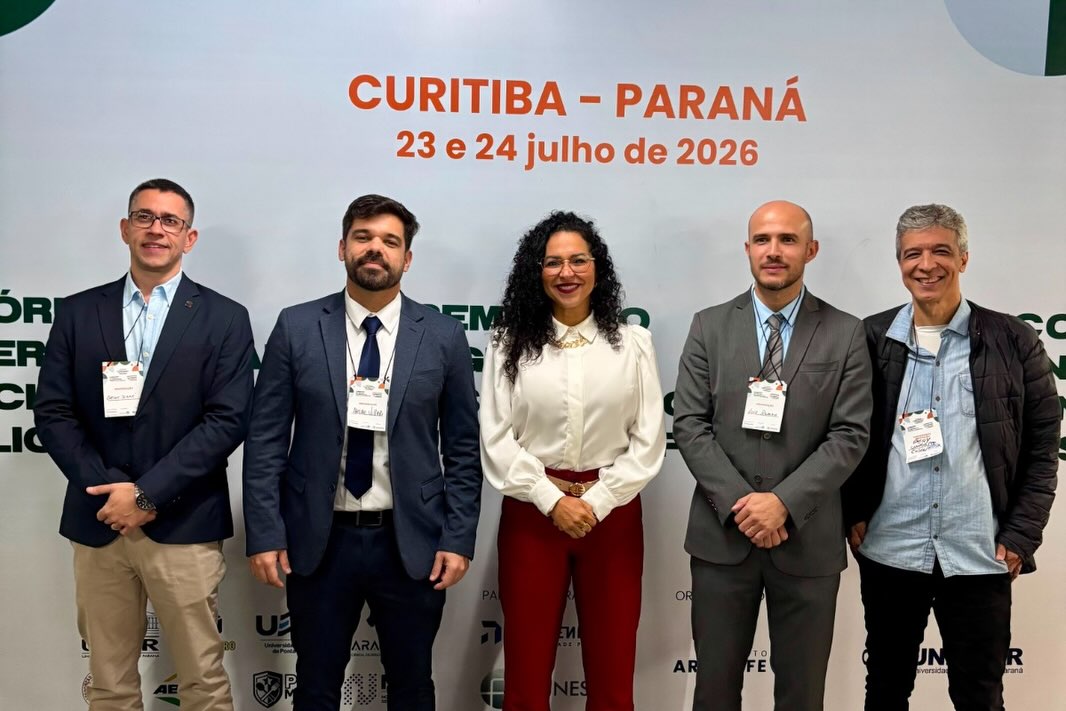

FICP Paraná 2026 establishes itself as one of Brazil’s leading events focused on Forensic Sciences and Evidence-Based Public Security
The III International Forum on Police Sciences – FICP Paraná 2026 was held on July 23 and 24, 2026, at the Mário Schoemberger Auditorium of UNESPAR, in Curitiba, bringing together Brazilian and international experts to discuss the main challenges and advances in contemporary public security.
With the theme “Forensic Sciences and Evidence-Based Public Security”, the event highlighted the role of technical evidence, forensic expertise, and evidence production in criminal investigations, police decision-making, public policy development, and the strengthening of the justice system.
Organized by Instituto Arrecife, with the support of the State University of Paraná (UNESPAR) and institutional support from the Paraná State Secretariat of Science, Technology and Higher Education (SETI), the Paraná State Secretariat of Public Security (SESP), and the Government of the State of Paraná, the forum established itself as an important space for integration among police institutions, universities, public agencies, researchers, and the productive sector.
The program also included the 2nd Paraná Public Security Management Seminar, linked to the Technical Residency Program and the Lato Sensu Graduate Program in Public Security Management (RESTEC-GESP), as well as the Paraná Meeting on Forensic Sciences, expanding dialogue among professionals, researchers, and managers in the field.
One of the event’s highlights was the opening keynote lecture delivered by Daniel J. Wescott, director of the Forensic Anthropology Center at Texas State University and an internationally recognized expert in Forensic Anthropology. In his presentation, the researcher addressed the relationship between Forensic Anthropology and Evidence-Based Policing, emphasizing the importance of science in criminal investigations and in improving police practices.
Throughout the two-day program, FICP promoted discussions on strategic topics for public security, including forensic sciences, organized crime, cybersecurity, digital crimes, urban dominance, fraud and counterfeiting, the prison system, police training, firearms and tactical shooting, civil defense, disaster management, violence against women, applied technologies, and public policies.
In addition to the international conference, the event featured roundtables, thematic panels, workshops, a research seminar, scientific paper presentations, and an exhibition area dedicated to partner institutions and companies. The audience included police officers, forensic experts, public managers, researchers, professors, members of the Judiciary and Public Prosecutor’s Office, municipal guards, students, and representatives from the technology and defense sectors.
More than a scientific conference, FICP Paraná 2026 reinforced its role as a national hub for science, innovation, and integration in public security, promoting connections among experts, institutions, and organizations committed to strengthening applied research and evidence-based public security.
Following the editions held in Rio de Janeiro in 2024 and Salvador in 2025, the Curitiba edition consolidated the growth trajectory of the International Forum on Police Sciences, expanding its national and international relevance and strengthening its contribution to the development of Police Sciences in Brazil.
Highlights of FICP Paraná 2026
- International conference featuring Daniel J. Wescott from Texas State University;
- Integration with the Paraná Meeting on Forensic Sciences;
- Organization of the 2nd Paraná Public Security Management Seminar – RESTEC-GESP;
- Thematic panels on organized crime, cybersecurity, forensic expertise, the prison system, and urban dominance;
- Specialized technical workshops, including Tactical Emergency Medical Care (Tactical EMS);
- Research Seminar on Police Sciences;
- Exhibition area for partner institutions and companies;
- Participation of a highly qualified audience from the fields of public security, justice, technology, defense, and research.