

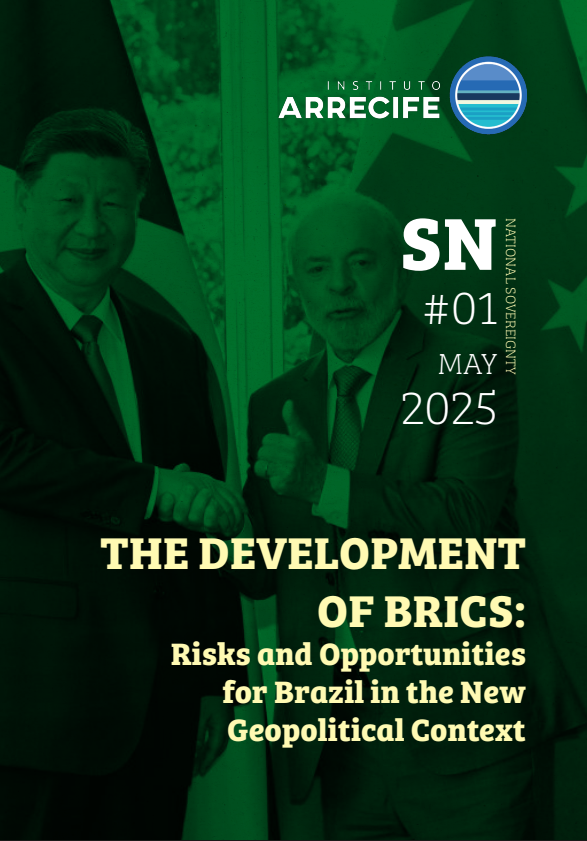
In the report "The Development of BRICS: Risks and Opportunities for Brazil in the New Geopolitical Context", the first in the National Sovereignty series, political scientist Osmar Bernardes Júnior provides a detailed analysis of the evolution of the BRICS bloc and its impact on Brazil. Initially created as a forum for emerging economies with an economic focus, BRICS has transformed over the years into a geopolitical instrument, with China's growing dominance beginning to shape the political and economic directions of the group.
The recent expansion of BRICS, with the inclusion of new members such as Iran, Saudi Arabia, and Argentina, highlights the bloc's attempt to become a counterweight to the Western-led international order. However, as the group becomes more diversified, it is increasingly driven by China's expansionist agenda and growing hegemony, which not only dominates the economic decisions within BRICS but also exerts political influence over the other members.
This report evaluates the internal dynamics of BRICS and how Brazil, by aligning itself with the bloc, faces a difficult strategic position. China, with its growing economic and military power, not only controls financial decisions within the bloc but also imposes an agenda that does not necessarily reflect Brazil’s interests. With the creation of BRICS+, the bloc moves further away from its original idea as a purely economic platform, now positioning itself as a tool of contestation against the international system led by the U.S. and Europe, where Washington's interests often conflict with China's.
Based on the analysis of the Final Declaration of the XVI BRICS Summit, this study seeks to identify how China's agenda is shaping the future of the group, what risks Brazil may face by aligning with an increasingly assertive China, and how the country can seize opportunities without compromising its political and economic autonomy on the global stage.