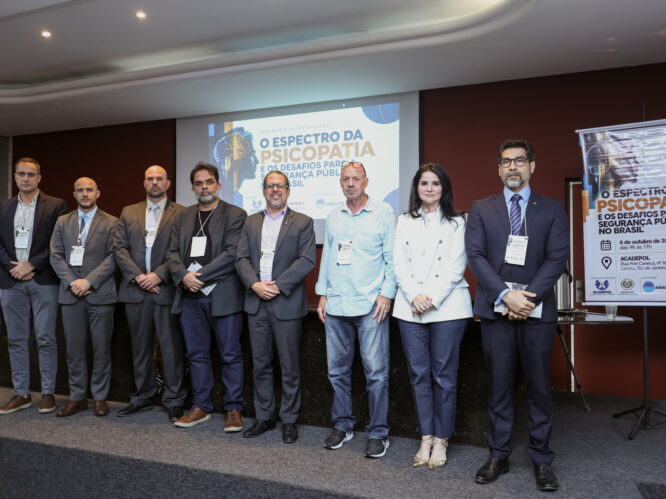
The event brought together Brazilian and international experts to discuss the connections between biosocial criminology, neuroscience, criminal justice, and public security. The program also featured the launch of the Brazilian edition of Matt DeLisi’s book Psychopathy as a Unified Theory of Crime.
On October 6, 2026, Instituto Arrecife held the International Symposium “The Spectrum of Psychopathy and the Challenges for Public Security in Brazil” at the Sílvio Terra State Police Academy (ACADEPOL) in Rio de Janeiro, Brazil. The event brought together researchers, legal professionals, and representatives of public security institutions for a program dedicated to advancing scientific discussions on psychopathy and its implications for understanding antisocial behavior, criminal justice, and violence prevention.
Funded by the Carlos Chagas Filho Foundation for Research Support of the State of Rio de Janeiro (FAPERJ), the symposium sought to bridge international scientific research and the challenges faced by Brazilian institutions, fostering interdisciplinary dialogue among biosocial criminology, neuroscience, criminal law, and public security.
Biosocial Criminology and the Spectrum of Psychopathy
The program opened with an institutional session featuring Bruno Gilaberte, Director-General of ACADEPOL; Wilson Palermo, Director of Education at the Academy; and Eduardo de Alencar, President of Instituto Arrecife and coordinator of the symposium.
The morning’s highlight was the international lecture “Biosocial Criminology and the Spectrum of Psychopathy,” delivered by Kevin Michael Beaver, a criminologist and professor at Florida State University (USA), recognized for his research in biosocial criminology. The session was moderated by Sávio Pontes and featured simultaneous English–Portuguese interpretation.
The lecture explored contributions from biosocial criminology to the study of antisocial behavior, considering the interplay between biological and environmental factors. The discussion provided an opportunity to examine the scientific foundations of human behavior and the potential applications of this knowledge to criminological research and the development of prevention strategies.
Book Launch: Psychopathy and a Unified Theory of Crime
The program also featured the launch of the Brazilian edition of Psychopathy as a Unified Theory of Crime, by Matt DeLisi, published by Editora Arrecife in 2026.
The book contributes to academic discussions on the relationship between psychopathy and criminal behavior, engaging with theoretical approaches that seek to explain the factors associated with crime. The launch reinforced the symposium’s scientific and publishing dimensions, highlighting the importance of making specialized research and academic references more widely available in Brazil.
Roundtable Examines Criminal Justice and Public Security in Brazil
In the afternoon, the roundtable “Psychopathy, Criminal Justice, and Public Security in Brazil” brought together experts from different fields to discuss the implications of the subject in the Brazilian context.
The participants were:
- Eduardo de Alencar — Sociologist, PhD from the Federal University of Pernambuco (UFPE), and President of Instituto Arrecife.
- Kevin Michael Beaver — Criminologist and professor at Florida State University.
- Michele Abreu — Doctoral candidate and Master of Laws in Criminal Law at the Pontifical Catholic University of São Paulo (PUC-SP), specializing in Criminal Law and Criminal Procedure.
- Renato Rozental — Physician, neuroscientist, and researcher in Disaster Medicine.
The discussion was moderated by Luiz Ramiro, a political scientist with a PhD from the Institute of Social and Political Studies at the State University of Rio de Janeiro (IESP-UERJ) and a co-founder of Instituto Arrecife. Simultaneous English–Portuguese interpretation was provided.
The roundtable offered an interdisciplinary examination of the relationships between psychopathy, criminal behavior, and criminal responsibility, bringing together perspectives from criminology, law, and neuroscience. The discussion also highlighted the importance of connecting academic research with the practical demands of institutions responsible for criminal investigations, the administration of justice, and public security.
Connecting Scientific Research and Police Training
By taking place at ACADEPOL, the symposium also provided a forum for dialogue between the scientific community and professionals involved in police education and practice.
The institutional participation of the Sílvio Terra State Police Academy and the Civil Police of the State of Rio de Janeiro (PCERJ) underscored the importance of cooperation among research institutions, academic organizations, and public security agencies in fostering informed discussions on complex phenomena associated with criminal behavior.
The closing session featured Bruno Gilaberte, Sávio Pontes, and Wilson Palermo, representing the institutions involved in organizing and supporting the event.
A Commitment to Scientific Research and Knowledge Dissemination
The International Symposium “The Spectrum of Psychopathy and the Challenges for Public Security in Brazil” reflects Instituto Arrecife’s ongoing commitment to promoting research, professional development, and the dissemination of scientific knowledge in areas related to criminology, criminal justice, and public security.
By bringing together Brazilian and international experts, the event helped expand the discussion of psychopathy and its relationship to criminal behavior, emphasizing interdisciplinary collaboration and academic exchange as essential tools for addressing the complex challenges facing Brazilian institutions.
The event was organized by Instituto Arrecife with funding from FAPERJ. Institutional support was provided by the Sílvio Terra State Police Academy (ACADEPOL) and the Civil Police of the State of Rio de Janeiro (PCERJ).
EVENT INFORMATION
Institutional Support: ACADEPOL and the Civil Police of the State of Rio de Janeiro (PCERJ)
Organizer: Instituto Arrecife
Funding: FAPERJ — Carlos Chagas Filho Foundation for Research Support of the State of Rio de Janeiro